This
section contains information that may help you with your
Genealogical Research.
Many of the items
appeared previously in the Genealogy News
section.
*****
In addition to
these tips, further suggestions on research can be found in
the "Genealogy Research" section and in some of the
"Genealogy Articles". ****
Scottish Handwriting
!!! New !!!
Clansfolk who have researched original old Scottish records will know how difficult it can be to read the handwriting.
We are pleased to report that National Records of Scotland (NRS) have come to the rescue and have made available free of charge a booklet entitled 'Scottish Handwriting, 1500-1700, A self-help pack' written by Alison Rosie. It can be read or downloaded by clicking here. This has been described as "a valuable asset to those with an interest in researching Scottish History at source".
*****
Added 31/03/2023
Last updated 31/03/2023
Scottish Pre-1841 Population Lists
Researchers know just how valuable are the Scottish Census records on Scotlandspeople website. As the census returns are only available from 1841, some pre-1841 population lists may help find earlier ancestors.
The Scottish Association of Family History Societies has a free database on its website entitled Pre-1841 Population Listings. This database lists the locations of many useful early sources that can be researched.
*****
Added 18/07/2021
Last updated 18/07/2021
Scottish Burial Grounds
One of the very useful sources of information for your family history is to find headstones relating to your ancestors. It starts with knowing the likely burial ground and for Scotland, the Scottish Association of Family History Societies has a free finding aid on its site. The
Burial Grounds database of over 3500 sites, notes where all known Scottish burial grounds exist, if their transcriptions have been recorded/published, and where they can be consulted.
*****
Added 18/07/2021
Last updated 18/07/2021
Starting your Genealogy Research
!!! Recent !!!
Step one is to collect any information about your parents and grandparents that you know of and any related documents you might have within your family. If you have brothers and sisters, parents and grandparents alive then also talk to them, especially about their deceased ancestors. The main details to seek are names, births, deaths and marriages, the various places where they lived and broadly what they did in their lifetime. You could also collect information about uncles and aunties, and cousins. But avoid getting bogged down with too much information at this stage.
You could also go to your public library and borrow a “how to” book or books, especially on American research and perhaps research in the UK. Or you could use a website such as familysearch.org to look at their wiki section by searching for research generally or America to start off with.
Before you start to use the familysearch website you will need to register - it’s simple and free. At this stage you do not need to access websites like ancestry or myheritage where you will have to pay to subscribe to gain access. Also you can leave having a DNA test until you know more about your ancestors.
Realise you will probably end up with a lot of paperwork, or files on your computer so give some thought as to how you might keep some order, such as at least a file on each direct ancestor.
After you have collected information within your family, write up a brief family tree. In doing this you might consider using the two forms on the Clan website.
If you establish the birth, marriage and death details of your grandparents. your research may develop quickly because there may be trees online related to your ancestors that can be used to guide you in your research. At this stage the Clan’s Sennachie may be able to help. So when you have some information about your grandparents please contact the Sennachie who may find additional information, or if needed, to advise of further research avenues.
Please appreciate that finding everything quickly and easily on the internet may not occur. Lots of information may not be online.
*****
Added 06/06/2020
Last updated 10/06/2020
Old Canadian Directories
Old directories are useful for tracing the movements of ancestors. A very useful site is the Canadian Directories Collection on the Libraries and Archives Canada website. This Collection is a database of scanned, microfiche versions of pre-1901 Canadian directories. There are 95 directories in the database, which contains a searchable section covering a range of different locations including Halifax, Montreal, Ontario, Ottawa, Nova Scotia and more. Some additional directories are available in PDF format and are not in the searchable database - namely for Hamilton, Kingston, London and south west counties of Ontario.
*****
Added 06/11/2019
Last updated 06/11/2019
Relationship Calculator
Have you wondered what the relationship is between yourself and a distant relative. There are many sites on the internet to help establish the degree of relationship between two people who have a common ancestor.
Two different approaches can be viewed by clicking here and here.
*****
Added 28/04/2019
Last updated 28/04/2019
On-Line Newspaper Archives
One of the most useful sources for anyone undertaking research into your family, local history or even general history, for anywhere in the world, is old newspapers. In one respect researchers need to be careful of any information published in newspapers because they are not a primary source and therefore could contain errors. For example a birth certificate is a primary source and a birth notice in a newspaper is a secondary source and could include transcription errors.
A most useful website that will indicate what old newspapers are online and searchable, is the Wikipedia page on newspaper archives - click here to visit it. This site will lead you to many other useful sites about published newspapers. For example, to the Library of Congress and to the British Newspaper Archives. For some countries access to old newspapers is free and comprehensive by going to one website, for example Australia and New Zealand. Some sites are free and others charge a fee.
*****
Added 26/04/2019
Last updated 26/04/2019
Billion Graves
*****
The "Billion Graves" free to use website contains a
world-wide collection of information obtained from headstones
in cemeteries, and from burial records. Its strength is
American records. Billion
Graves data is
also accessable through their partner web site findmypast, for
example Scotland.
*****
The site may
assist with extending your research into your family history.
Finding a death date can lead to lots of information about a
person’s life. Once a death date has been
determined, the death certificate or, if before civil
registration (vital statistics), a burial extract from a
parish register can be obtained. A check can also be made
for a death notice, a funeral notice and for a will. The
cemetery where the person is buried can also be visited.
*****
Added
12/01/2018
Last updated
13/01/2018
Translating Latin Phrases
*****
Latin Script
When examining ancestral records you are quite
likely to come across phrases in Latin. Wills, parish
records and land records in particular tend to contain such
latin terms. Some researchers may not have studied the
Latin language as part of their education or, like
your Webmaster, may have now forgotten all that they
ever learnt!
*****
We have recently
found a website that provides useful translations - please
click here to
visit it.
*****
Added
25/05/2016
Deceased Online - UK & Ireland
Burials **** Dece
ased Online is the first central database of statutory burial
and cremation registers for the UK and Republic of Ireland.
This growing database, holds records mainly from the 1850s
onwards. Recently many records from Aberdeenshire were added
to the site. Searching is free, and can be restricted as
required to country, region, county, or individual burial
authority or crematorium. If you register with Deceased
Online, you will be able to purchase vouchers online, which
you can spend to access further information associated with
any of the found records. ****
**** Added
31/03/2014
FreeReg, FreeBDM and FreeCen Indexes
*****
The following
indexes are free to access. It should be appreciated
that the indexes are not necessarily complete. Each site has a
page which gives details of its coverage. Volunteers have been
adding to these indexes over many years.
*****
FreeReg
- Transcriptions of pre civil registration parish registers
for England, Scotland, and Wales of baptism, marriage, and
burial records, and includes non-conformist registers of the
U.K. As at early 2014 the FreeREG database contains
4,489,455 Marriages, 13,625,155 Baptisms and 9,387,547
Burials.
*****
FreeBMD
- is a database of England and Wales General Register Office
birth, marriage and death indexes from 1837. The FreeBMD
Database contains 236,907,482 distinct
records.
*****
FreeCEN
is a database of census information extracted from UK census
records. The FreeCen Database contains 25,655,878
entries.
*****
Added
30/03/2014
Births, Deaths and Marriages
*****
For some countries researchers can access online indexes of
the civil registration of births, deaths and marriages. Also,
as is the case for Scotland from March 1855, it may be
possible to purchase online an image of the actual entry in
the register.
****
Online indexes
are easier to update, which means as each year passes another
year is added to the indexes, and possibly, as in Scotland,
access to another year of entries. Which means in
Scotland, for example, soon after 1st January each
year.
*****
The arrival of
2014 means that an additional year of images is available on
the ScotlandsPeople website. You can now view the images of
the statutory records for births in 1913, marriages in 1938
and deaths in 1963. This updating of the records occurs in
January each year.
****
This occurs in
other countries/states, for example in New Zealand and New
South Wales. So it could be worthwhile checking each January
to see if you are able to add further information to your
family tree.***
It is strongly
recommended that if you are just starting to research your
Wiki
family history, you should first learn about the records to be
researched. This can be done by purchasing "how to"
books, or borrowing such books from your local library.
You can also find advice on the internet and one of the best
sites is the wiki
section of FamilySearch. Simply search for the
country you are researching and the first result is a general
page which leads to many subjects; for example Scotland.
You can also search for a topic, but when doing so it is best
to also include the country, for example, cemeteries
scotland.
****
Also there is some advice in other pages of our website
under other Genealogy sections.
****
Added 03/11/2013
Scottish Old Parish Registers, pre 1855. ****
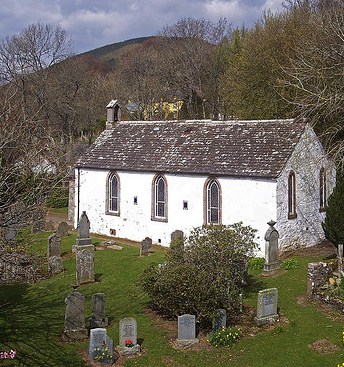
Rural Scottish Kirk
As your family history research in Scotland moves back beyond
1855, that is pre civil registration, the most important
source will be the Old Parish Registers. These are the
Church of Scotland parish registers of baptisms (or births),
marriages (or the proclamation of banns) and burials (or
deaths). **** Parish
registers are generally held by the parish minister, and there
are about 900 parishes in Scotland. There was no standard
as to how the events were recorded, which means that for
many events only the bare minimum of information was recorded,
eg, name of child, date of baptism and name of the father. On
the other hand some ministers recorded much more. To a
large extent it depended on the minister. **** The earliest registers
date from the mid 1500's, while some started in the 17th and
18th century. Some were recorded in Latin. Also as time
went on and the population increased, some people avoided the
Church, especially during the period 1783 to 1794 when a stamp
duty of threepence was payable for each event recorded in a
parish register. **** Many families were non-conformists and
did not have the event recorded in the parish register, but
then again many did, as well as in the non-conformist
registers.
****
Research - the
website FamilySearchshould
be searched first. Over the years the Scottish General
Register Office has obtained and indexed many old parish
registers, and Catholic Church registers, so the indexes and
entries can be searched for a fee by going to the website
ScotlandsPeople. **** More details about Church
records can be found in any good “how to” books on Scottish
research and articles on some websites. **** Added
19/10/2013
Updated
20/10/2013
Scottish Births, Deaths and Marriages from
1855
*****
Civil registration (or vital
statistics) of births, deaths and marriages in Scotland
commenced on 1 March 1855. This replaced the requirement
for these events to be carried out by the Established Church,
that is, the Church of Scotland, who performed baptisms,
marriages and burials, and still does. Registration is
compulsory regardless of religious denomination and follows a
standard format for each, which results in the collection of
more information than before 1855. Also records and
indexes are centralised in Edinburgh, although copies are held
in the local district.
***** During 1855 the law required the
collection of much information, which is a bonus for
researchers. There were many objections to collecting so
much information and the law was changed as from 1 January
1856. Since then, for example, a birth certificate
should record the child’s name, date, place and time of birth,
sex, the parents' names (including maiden surname of mother),
father's occupation, name of informant and relationship to
child.
***** To obtain a civil registration certificate go to the
General Register Office for Scotland or the ScotlandsPeople
Centre. There will be a fee. Some births, deaths and
marriages for Scotland have been indexed by familysearch.org,
and it is suggested this index should be checked first as it
is free.
A2A is part of the UK archives network. The A2A database
contains catalogues describing archives held locally in
England and Wales by about 400 record repositories other than
the National Archives at Kew. These records date from the
eighth century to the present day.
*****
As an example, if
a search is carried out for MacThomas, you will find a letter
written in 1600 that makes mention of a James MacThomas. This
document is held by the Lambeth Palace Library.
The Society's website, under Genealogy, includes some articles
on how to conduct your research, a selected list of useful
websites, a list of various books that may assist,
several indexes, answers to research enquiries, and advice on
finding a family history society. All of these may help
you with your research.
*****
However, you may
need further assistance. As well as checking your local
library for "how to" books, and using your search engine to
locate articles on particular topics, perhaps one of the
best places to look for advice is the Church of Jesus
Christ of Latter-Day Saints' "Family Search" website. Not only
can you use this free site to search for names, but you can
also read many articles on research topics covering most
countries and issues or view their various videos. Click here
to access their learning resources page.
*****
Added 30/10/2012
Rootsweb
*****
One
of the most useful free websites when researching your family
tree is a worldwide site Rootsweb. This site contains a number
of features:
●
Searches -
provide access to searchable
websites.
●
Family Trees -
many researchers place their data on this site and these
can be searched by anyone. The site claims 680 million
names on file. But a word of warning; there can be
dubious information and, as with any good research, you
should check the original source.
●
Mailing Lists -
A very useful way of helping you find information about
your ancestors and to connect you with people who have
similar interests.
●
Message Boards - Another facility to enable you
to raise questions or to make comments about any family
history matter.
●
Websites - You
can access thousands of very useful websites. Some are
rootsweb sites and others are hosted by
rootsweb:
The National Library of Scotland has a section on it's web
site of Scottish Post Office Directories that can be very
useful for family history and local history research.These annual
directories include an alphabetical index of a town or county
residents where you may find the location of where your
ancestor was living at a certain time.
*****
You can access online 694 directories for the
period 1773 to 1912 covering 28 towns and counties of
Scotland.For
example, there are 88 Directories for Aberdeen covering the
years 1824 to 1912 and 29 covering Perth and Perthshire for
the years 1837 to 1912.
*****
The directory illustrated includes several
references to the 15th Chief of Clan MacThomas, Patrick Hunter
Thoms of Aberlemno.
In
1939, the National Registration Act ordered a register of
everybody living in the United Kingdom for the purpose of
issuing identity cards, ration books and call-up papers. The
register has been kept secret because the
1939 Act prohibited publication of the information. However,
under the Freedom of Information (Scotland) Act 2002, that
restriction has now been reviewed and details about people who
have since died are being made
available.
The
General Register Office for Scotland will give details of
people now deceased when provided with a full name, date of
birth, death certificate (died outside Scotland) or date of
death if died in Scotland. There is a charge of £15 reduced to
£5 if the search proves to be unsuccessful. Payment by credit
card is accepted. Please link here
for further details.
Added 04/07/2010
Updated
05/06/2011
Moved From
News 28/01/2012
National Library of
Scotland
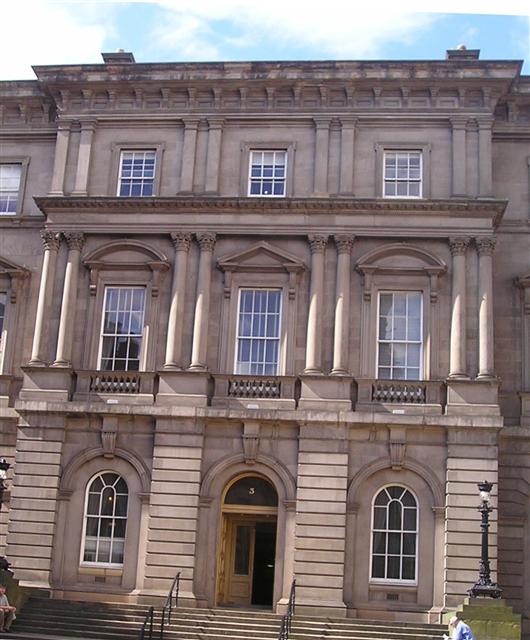
The National Library of Scotland web site has many
features that may interest genealogists or those members just
interested in "things" Scotland. For example, this site has
some very good general guides on researching your Scottish
genealogy. Also there are digital images of maps, post office
directories, photographs, and many other images relating to
life in Scotland.
Researchers should try to establish the date and place
of death of all their deceased ancestors. In doing this
additional information may be found and knowing the death date
could lead to finding an obituary and a will. There are many
web sites that may assist in establishing death details,
however there is one site that says it has listed cemetery
records online from "thousands of cemeteries across the
world". For example: www.interment.net.
Another example is the
Australian Ryerson Index which lists "contemporary death
notices and obituaries in Australian newspapers": www.ryersonindex.org
*****
Sennachie
Added
30/03/2011
Moved from
News 28/01/2012
Biographies
Many countries now have
online sites for biographies of well-known citizens and many
will feature people with names that relate to the Clan
MacThomas. Some sites are free to search, while some require a
payment. Also some countries may have a number of sites so you
may need to use your search engine. Entries may also be found
on Wikipedia. The following are representative of what you
might find:
Members researching their family trees may find
the "Deceased on Line" website to be of interest. The site
is the first
central database of statutory
burial and cremation registers for the
UK and Republic of Ireland and is said to provide a unique
resource for family history researchers and professional
genealogists.
The site was launched in July 2008,
and over time a substantial database of tens of millions of
burial and cremation records dating from 1850 is being built.
Data from all over the UK and Ireland is being added as new
burial authorities and crematoria join the
scheme.