The article below was
first issued as a handout to accompany our Sennachie's
presentation at the 2017 International Gathering in Scotland.
If you have any comments or questions please contact the Sennachie.
The use of DNA in Family History
Research
by
Grahame Thom, Sennachie.
Having
recently had my DNA (Deoxyribonucleic acid) tested by two DNA
family history companies, I thought I would pass on my
thoughts about the benefits of DNA in family history research
- but please appreciate I am not an expert on this
issue.
There were three main reasons why I decided to have my DNA
tested:
1. Being a family historian, I felt it would be good
to have my DNA recorded for
use by future
generations.
2. To see what the results revealed in relation to
the origins of my paternal and
maternal lines.
3. To see if there were any matches to other persons
tested by these
organisations. Sometimes family
historians may decide to have their DNA
tested
because they have a “brick wall”.
But
before talking about the outcomes, I thought I should first
say something about the tests that are available.
Our bodies are made up of millions of cells. Each cell has
23 pairs of chromosomes, 22 of which are matched pairs called
autosomes. Males and females both have these autosomes. The
remaining pair of chromosomes, called allosomes, is unmatched
and differs between males and females. It is they that
determine our gender; males have XY-chromosomes and females
X-chromosomes.
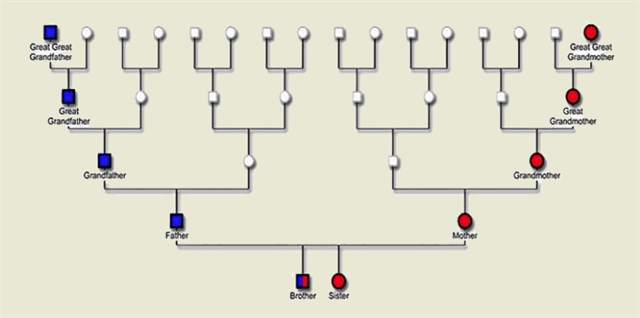
Males inherit their Y-chromosomes from their father and
their X-chromosomes from their mother. Females inherit
X-chromosomes from both parents. It is these differences that
make testing the way it is. Also testing for family history
purposes targets a limited number of the markers that make up
each chromosome. These have been identified through research
as being appropriate. Testing can be used for other purposes,
especially for medical assessments.
Generally a sample of saliva on a sterile swab is tested
to produce results for a series of DNA markers. For the
Y-chromosome test, the more you pay for a test means the more
marker results and the greater chance of a match. At this time
there are three types of tests for males and two for
females:
●
*
*
*
*
Y-chromosome DNA
- Only males have Y-chromosomes and this test gives an
indication of the community of your early male
ancestors. For example, my ancestral male line going
back in time through my father, grandfather Thom, great
grandfather Thom and so on.
●
*
*
*
*
*
*
*
*
*
*
*
*
*
*
Mitochondrial
DNA - For both males and females, this test is based on
the X- chromosome and takes your female line back to a
female that lived many thousands of years ago. This
means, for example, each female is likely to have a
different surname back to when surnames were first used.
In my case, my mother’s maiden name was Lane, her
mother’s maiden name was Russell, her grandmother’s name
was McClean, and so on.
Research has established that for people descended
from European females, there is a 95% chance that a
current day descendant will be descended from one of the
“Seven daughters of Eve” so named by Bryan Sykes,
Professor of Genetics at Oxford University. Wider
research is indicating that all people today are
descended from only about 30 females. This is because,
over the centuries, not all females had children or only
had male children.
●
*
*
*
*
*
*
*
Autosomal DNA -
This test looks at the DNA markers of all ancestral
lines. However, today’s technology can only do this with
a good degree of accuracy for five generations. For
example, I have a cousin with a link eight generations
back in Scotland and if we had our Autosomal DNA tested
the results would not give a reliable connection. This
is the test that is usually used to confirm parents of a
living child.
Not all DNA testing
organisations offer the autosomal DNA test, and they may offer
different marker numbers for the Y-chromosome test. Also for
the Y-chromosome DNA the test can be further refined if you
pay more for a SNP analysis.
Today if a female wants to know about her father’s origins
through a Y-chromosome DNA test then she has to submit a swab
taken from her father, or his father. If they are deceased,
then she needs to ask a brother or uncle to submit a
swab.
As an example relating to the Mitochondrial test - in
recent years, this test was used to confirm that the remains
found near Ekaterinburg in Russia were of Tsar Nicholas II and
his family. Two male living cousins of the Tsar having the
same direct female ancestral lines as the young Prince,
volunteered their DNA and were found to match the Tsar and his
son. Another example was testing many people in Polynesia,
South America and Asia, to see whether the Polynesians were,
many generations ago, descended from females in South America
or Asia. It was proved they were descended from Asian females.
In 2013 I undertook the first two tests mentioned above
with Oxford Ancestors. My Y- chromosome test indicates a high
probability of my male Thom ancestors being Celtic. My
mitochondrial test indicated my female line went back to one
of the ”seven daughters of Eve”, who has been given the name
Jasmine. When I checked the database of my testing
organisation I found 12 matches for my Y-chromosome 15
markers. But none had the Scottish connections, nor my
surname.
With FamilytreeDNA (tested in 2015 and 2016) I had all
three tests. I have had three positive connections based
on the Autosomal test - a first cousin in Australia and two
4th cousins in Canada had a match with my Weir ancestor.
I had already been in touch with another Weir cousin in
Canada, who was related to the new contacts, so these matches
did not produce anything new. My first cousin has been
researching for many years. I also have a near match
with a Clan Society member in the US. We both have Thom
ancestors from the same parish in Scotland, but again I knew
this before taking the test.
Because of changing technology, earlier this year I
decided to have my DNA tested for a third time with LivingDNA,
a new firm based in England. Its prices were reasonable and
the testing seemed more comprehensive. I have provided the
sample and await the results. The cost of tests continues to
come down as more and more tests are carried out.
There are other
companies that carry out DNA testing for family history
purposes, including AncestryDNA, My HeritageDNA and 23 and
Me. One interesting aspect for DNA testing, is that
FamilytreeDNA, for example, supports Name Groups. After
testing you can join a relevant Name Group. I joined the Thom
and Scotland groups.
All companies
report results on-line and users are given an ID and password
to access their details and any groups you have joined. All
offer access to help and each Name Group has an administrator
who can be e-mailed for advice. Discussion about results and
how testing works is very technical. However one can simply do
nothing as, for example, FamilytreeDNA sends e-mails advising
of possible matches.
There are lots of information about DNA in book form and
online. One interesting web site is:
DNA technology is
in its early years of development and as the data banks of
test results increase so will the technology improve and more
comparisons will produce more possible matches. I think,
generally speaking, when researching family history, DNA
testing is a good tool to use.



 ut
before talking about the outcomes, I thought I should first
say something about the tests that are available.
ut
before talking about the outcomes, I thought I should first
say something about the tests that are available.