Thomas, a Gaelic speaking
Highlander, known as TomaidhMor ('Great Tommy'),
from whom the clan takes its name, was a descendant of the
Clan Chattan Mackintoshes, his grandfather having been a son
of William, 8th Chief of Clan Chattan.
Thomas lived in the 15th century, at a
time when the Clan Chattan Confederation had become large and
unmanageable and so he took his kinsmen and followers across
the Grampians, from Badenoch to Glenshee where they settled
and flourished, being known as McComie (phonetic form of the
Gaelic MacThomaidh), McColm and McComas (from MacThom and
MacThomas).
To the Government in Edinburgh,
they were known as MacThomas and are so described in the Roll
of the Clans in the Acts of the Scottish Parliament of 1587
and 1595 and MacThomas remains the official name of the Clan
to this day.
The early chiefs of the Clan
MacThomas were seated at the Thom, on the east bank of the
Shee Water opposite the Spittal of Glenshee, the site thought
to be that of the tomb of the legendary Diarmid of the
Fingalian saga, with which Glenshee has so many
associations.
In about 1600, when the 4th Chief,
Robert MacThomaidh of the Thom was murdered, the chiefship
passed to his brother, John McComie of Finegand, about three
miles down the Glen, which became the seat of the
chiefs.
Finegand is a corruption of the
Gaelic 'Feith nen Ceann' meaning 'burn of the heads' and
refers to the time when some tax collectors were attacked by
some clansmen, who cut off their heads and threw them in a
nearby burn. By now, the MacThomases had acquired a lot of
property in the glen and houses were well established at
Kerrow and Benzian with shielings up Glen
Beag.
The time was spent breeding cattle
and fighting off those seeking to rustle them, one such
skirmish, in 1606, being remembered as the Battle of the
Cairnwell.
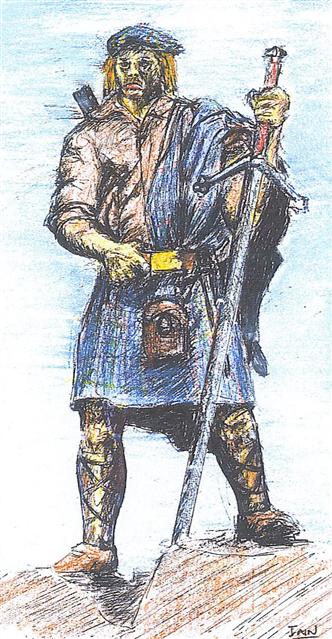
The 7th Chief was John McComie
(Iain Mor) and his deeds have passed into the folklore of
Perthshire and Angus, wherein he is generally known as
'McComie Mor' (illustrated). The legends surrounding this
Highland hero abound: he puts to flight some tax collectors in
defence of a poor widow single handed; he kills the Earl of
Atholl's champion swordsman; he slays the man who insulted his
wife; he fights his son in disguise to test his courage: he
overcomes a ferocious bull with his bare hands: and he is even
familiar with the supernatural.
Today, a large stone at the head of
Glen Prosen is known as McComie Mor's Putting Stone, a nearby
spring as McComie Mor's well, while at the top of Glen
Beannie, a rock shaped like a seat is called McComie Mor's
Chair.
Iain Mor joined Montrose at Dundee
in 1644, and fought for the King's cause throughout the
campaign, personally capturing Sir William Forbes of
Craigivar, but after the defeat at Philiphaugh, he withdrew
from the struggle and devoted his energies to cattle raising.
During this time the clan extended its lands and influence
into Glen Prosen and Strathardle and Iain Mor purchased the
Barony of Forter in Glenisla from Lord Airlie. Forter Castle
had been burnt eleven years earlier, as recounted in the
ballad, 'The Bonnie House of Airlie' and so Iain Mor made his
home at Crandart, two miles north of the
castle.
The Government of Cromwell won Iain Mor's
admiration for the prosperity it brought Scotland but this
soured his relationship with Airlie. On the restoration of
Charles II in 1660, he found himself in trouble with
parliament, who fined him heavily and at Airlie's instigation
a law suit decreed that the Canlochan Forest, part of the
Forter estate, belonged to the latter. This Iain Mor refused
to recognise, continuing to pasture his cattle on the disputed
land which Airlie had leased to Robert Farquharson of
Broughdearg.
Broughdearg was Iain Mor's cousin but the
dispute over the forest led to a bitter feud culminating in a
skirmish at Drumgley, just west of Forfar, where at a spot,
now known as McComie's Field, Broughdearg was slain on 28th
January 1673, along with two of Iain Mor's sons. The fine,
feud and the crippling law suit that followed ruined the
MacThomases, and following Iain Mor's death, his remaining
sons were forced to sell their lands.
The MacThomas chief is mentioned in
Government proclamations in 1678 and 1681 but the clan was by
now drifting apart with some going south into the Tay valley
changing their name to Thomson or into Angus and Fife where
they became Thomas, Thom or Thoms. The 10th Chief, Angus, who
took the surname Thomas and later Thoms, settled in Northern
Fife where his family thrived as successful farmers until they
moved to Dundee and became prosperous merchants, at the end of
the 18th century, finally buying the estate of Aberlemno near
Forfar.
Others moved north into Aberdeenshire,
where the name became corrupted to McCombie as well as the
anglicised forms Thom and Thomson. In Aberdeenshire, the
principal MacThomas family were the McCombie's of Easterskene,
and it is one of their party, William McCombie of Tillyfour,
M.P. for South Aberdeenshire at the end of the 19th century,
who is today regarded as the father of the world famous
Aberdeen-Angus breed of cattle.
Patrick Hunter MacThomas Thoms of
Aberlemno, 15th Chief, was Provost of Dundee from 1847 to
1853, while his heir, the eccentric George Hunter MacThomas
Thoms, advocate, bon vivant and philanthropist, became Sheriff
of Caithness, Orkney and Shetland in 1870, donating during his
lifetime large sums to St. Giles Cathedral in Edinburgh and,
upon his death in 1903, his vast fortune to St. Magnus
Cathedral in Kirkwall, together with the Aberlemno estate.
Having lost the Aberlemno estate, the chiefly family assumed
the name MacThomas.
In 1954, the Clan
MacThomas Societywas formed and 13 years
later, George's great nephew, Patrick Watt MacThomas, was once
again officially recognised by the Lyon Court by the
historic designation 'The MacThomas of
Finegand'.
He died in 1970, being succeeded as 19th Chief,
by his only son, Andrew
MacThomas of
Finegand. It was during his lifetime that the Clan's ancient
gathering ground (The
Cockstane)
was purchased, the new bridge over Shee Water named after the
family and the Clan's historic links with Glenshee firmly
re-established. Thomas, his only son, was born in the late
1980's.