Reprinted from
The Dundee Courier Advertiser, 16th December
2002.
Previously published in
Clach A’ Choilich, Volume 5, Number 7, 2003.
LISBETH
THOMS - AMBASSADOR FOR ARCHAEOLOGY
The Monday
Interview by Norman Watson
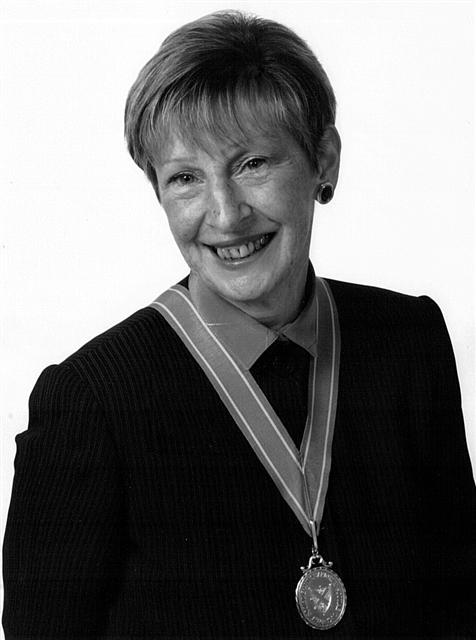
Lisbeth Thoms is
the new president of The Society of Antiquaries of Scotland.
The
society was founded in 1780. Even still, only one woman
previously has held the post, and presidents from hereabouts
are rare.
Originally from Kirkcaldy, Lisbeth works as a
freelance archaeologist and heritage advisor, operating as
Newgrange Heritage Services from Monifieth. She also lectures
part-time in the continuing education departments of Dundee
and Aberdeen universities.
She
says of the St. Andrews Day appointment, “To an extent you
never expect these appointments to come your way, and when
they do, you sort of think, ‘Oh, gosh me!’ And I suppose I am
feeling the honour and the magnitude of it all because when I
first joined the society 30-odd years ago when I was a student
in Edinburgh, I remember going to meetings, and thinking how
formal it all seemed. Now I suddenly find myself following in
very eminent footsteps!”
The
Society of Antiquaries of Scotland is the second oldest
antiquarian society in the UK. “So for the last 220-odd years
we have done what the society set out to do and that is to
study the antiquities and history of Scotland, but more
especially through archaeological research. But over the years
this has broadened enormously. Industrial archeology did not
even exist when the society was founded, for example.” Members
of the society are known as fellows. “There are some 3600
fellows now, not just in Scotland, but scattered around the
world. The society organises a programme of meetings, a
conference, and various seminars and
excursions.”
The society also
encourages and promotes research work and gives grants. It
boasts a marvellous record of publication and produces its
famous Proceedings, a wide-ranging record of research, in
annual volumes. It also has a flourishing north-east section
based in Aberdeen. Effectively, it flies the flag for
archaeology and history in Scotland, and
this sums up Lisbeth’s outstanding
career.
“If I
could put my finger on where my interest in the past began, it
was when I was studying ancient Egypt in the history class at
school. I was quite fascinated by the ancient Egyptians. And I
suppose at that stage, in my very early teens, I equated all
archaeology with Egyptology. Thereafter, of course, I realised
that the past was liter- ally on our
doorstep.”
Enthused by two years of archaeology on the way
to a geography degree at Edinburgh University, she took up a
post-graduate diploma course at Durham University. A career
beckoned. As did Dundee — “very happily” — where she worked
for Dundee Council in its various guises for 24 years,
becoming heritage services manager. During this period she
earned a reputation as a brilliant field archaeologist.
“Dundee museum service must be given credit for making one of
the first field archaeology appointments in Scotland,” she
added modestly. “This was in the early 1970s and there were
very few outside the universities, so it was quite far
thinking of the local authority. But, yes, I came here to get
my hands dirty, to do field work — and it was
fabulous!”
Lisbeth
helped to raise public awareness of archaeology in small-scale
digs in Dundee’s Overgate and St. Anne’s Lane in Perth. A much
larger excavation on the site of Marks & Spencer in Perth
attracted national headlines as it revealed the lives of
ordinary people through painstaking
analysis.
“In the
early 1970s there was an increasing awareness on the part of a
number of academics, historians, archaeologists, and others of
the major development work about to be undertaken in our towns
and cities. Much of the archaeology was going to disappear.
What we did was got people thinking and talking about
it.”
The
interest sparked 30 years ago continued, she says. Firstly the
development in the 1970s and 1980s meant a greater number of
archaeologists appointed to posts. “There was a tremendous
amount of what we call rescue excavation in advance of
developments. Secondly, there has been far more archaeology on
television in recent years — programmes such as Time Team and
Meet the Ancestors - which has raised its
profile.”
Lisbeth raised her
own profile at the end of 1996 when she decided to go
freelance. By then she had held appointments on several
bodies, including the Ancient Monuments Board for Scotland,
the Civic Trust and Abertay Historical Society. “Going freelance
was very much a jump into the unknown, but the phone rang within hours and it was Dundee University
asking me to do more lectures for them. I have always been
keen on lecturing. Throughout my years with local authority, I
felt it was important to tell people about
archaeology.”
Her new role as
president of The Society of Antiquaries of Scotland places her
at the heart of the nation's sense of belonging and identity.
“What we can study through archaeology
stretches the story of Scotland all the way back to the very
beginning. And yes, I do think a sense of place and identity
is very important for people to have. But it is not just in
these sort of emotional senses that the past can speak to. It
is very important in terms of tourism, heritage and economic
regeneration.”
Tourist-travelled herself to
the great archaeological sites of Peru, China and Egypt, but
based in coastal Angus, Lisbeth will be the first president of
the society for many years who neither lives or works in
Edinburgh or the central belt of Scotland. “So I shall be
bringing very much a Pictish perspective to it! I am conscious
too, that I will be the first president to have practised
their archaeology and heritage work in the local authority
milieu. Also, I am only the second woman president of the
society. But although my background and perspective will be a
bit different, I think that can be an advantage both to me and
to the society.”