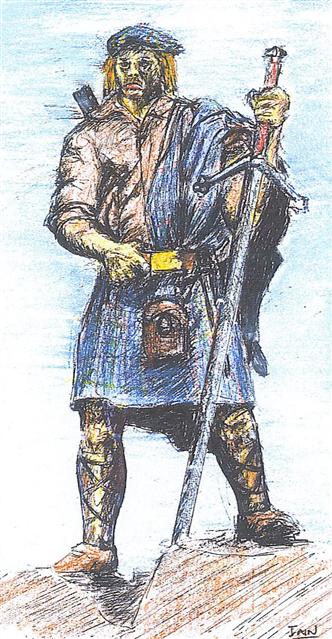
John McComie of Finegand and Forter, who succeeded to the
Chiefship of the Clan MacThomas on the death of his father,
Alexander, in 1637, was a legend in his own life time, a
Highland hero to this day and the most famous of the ancient
Chiefs.
The legends
surrounding McComie Mor (as he is often known) are numerous.
He put to flight some tax collectors in defence of a poor
widow; he killed the Earl of Athol's champion swordsman; he
slayed a man who insulted his wife; he fights his son in
disguise to test his courage; he overcomes a ferocious bull
and he is even familiar with the
supernatural.
In 1644, during
the British Civil War, the 7th Chief of Clan MacThomas joined
the Royalist Army and for the next two years served throughout
Montrose's "glorious" campaign with six brilliant victories.
But, after a crushing defeat at Philiphaugh, McComie Mor
returned to cattle raising in Glenshee and prospered to such
an extend that he was able to sell his seat at Finegand and
purchase the Barony of Forter, a much larger estate in nearby
Glen Isla.
Towards the end of his life, the 7th Chief
was won over by the prosperity the Protectorate brought to
Scotland and started to co-operate with Oliver Cromwell's men.
This was too much for his Royalist neighbours and when Charles
II returned to the throne in 1660, his envious enemies saw an
opportunity for revenge. A decree, lawsuit and a crippling
fine together with a damaging feud with the Farquharsons over land led to the murder of his eldest
and fourth sons at a skirmish at Drumgley near Forfar 1673 and
to his own death the following year.
McComie Mor’s
sense of fairness, unconquerable spirit, his gallantry and
courage coupled with his own extraordinary personal strength,
marked him out as a leader of men and a true Chief. In few
areas of Scotland, has the memory of a man who died so long
ago been maintained as vividly as that of John McComie of
Finegand and Forter.